Visual art and the reconstruction of the artist’s gesture: phenomenological arguments for an alternative mirror theory
Abstract
This contribution supports the idea that research on the beholder’s response to visual works of art benefits from recent suggestions from cognitive science about the role of embodied motor processes in experience. However, it argues that the current hypothesis of the beholder’s motor engagement that follows from the mirror neuron theory suffers from an inadequate view on the production of visual art, in particular with regard to the nature of the gestures involved. It therefore offers an account of the perception of visual works of art in which the role of embodied motor processes is central, but avoids a too “intentionalist” view on the artist’s gestures
- Keywords: Visual Art; Embodied Cognition; Mirror Neurons; Phenomenology; Gesture
Details
Source: pp. 139-153 in The New Yearbook for Phenomenology and Phenomenological Philosophy (Ed. Vassiliou, F.). Abingdon-on-Thames: Routledge.
Author(s): Helena De Preester
Year of publication: 2021
Descartes on the Passions of the Soul and Internal Emotions. Two Challenges for Interoception Research in Emotions
Abstract
René Descartes is not only praised as the father of modern philosophy, but he is also famous (or infamous) for mind-body dualism. In his later writings on the passions, however, it becomes clear that the passions of the soul do not fit well with the distinction between body and soul. We join the exploration of Descartes’s work on the passions of the soul and the union of the mind and the body. On the basis of Descartes’s account of the passions of the soul, we argue that current interoception-based theories of emotions cannot account for the hallmark of a passion of the soul, i.e. that its effects are felt as being in the soul itself. We also pay attention to the epistemic functions of the passions and to Descartes’s belief that there is a category of emotions which “are caused and occur in the soul alone”. This is the class of internal or intellectual emotions that seems to reinstate mind-body dualism. As Descartes describes them, certain passions of the soul, but also certain internal or intellectual emotions are similar to, what are called today, epistemic feelings (also called noetic feelings) and epistemic emotions, collectively referred to here as epistemic affect. Descartes’s work on the passions and on internal and intellectual emotions reflects another challenge for contemporary embodied cognition in the effort to overturn Cartesian dualism: how might epistemic affect be embodied? Since the signature of embodiment is increasingly understood as written in interoceptive information, the challenge to interoceptive research is demonstrating the degree to which (epistemic) affect results from the processing of interoceptive information. This challenge also implies that the locus of emotional experience is taken into account.
- Keywords: Descartes, passions of the soul, internal emotions, intellectual emotions, mind-body dualism, epistemic affect, interoception, noetic feelings, epistemic feelings, epistemic emotions
Details
Source: Danish Yearbook of Philosophy 2021, pp. 1-28.
Author(s): Helena De Preester, John Dorsch
Year of publication: 2021
A radical phenomenology of the body: subjectivity and sensations in body image and body schema
Abstract
The role of sensations for body experience and body representations such as body image and body schema seems indisputable. This chapter discusses the link between sensory input, the experience of one’s own body, and body representations such as body image and body schema. That happens on the basis of Michel Henry’s radical phenomenology of the body, which unites body and subjectivity and reconsiders the role of sensory input for the experience of the body and related representations. Without supporting, but inspired by, Henry’s ontological dualism between subjective and objective body, it is argued that the traditional view that considers sensory signals as all-important for bodily experience misses out a bodily dimension crucial for subjectivity—the body’s subjective dimension, not reigned by current sensory input.
This chapter has a twofold aim. First, it introduces Henry’s little-known, but radical, phenomenology of the body. Second, and based on Henry’s phenomenology of the body, it shows that attention for the subjective body is at odds with the all-important role of sensory signals in the current embodiment studies.
- Keywords: embodiment, sensory signals, sensations, Michel Henry, phenomenology, bodily experience, body image, body schema, body representations, subjective body, objective body
Details
Source: In Body Image and Body Schema Revisited (Eds. Tanaka, S., Ataria, Y., Gallagher, S.). Oxford: Oxford University Press.
Author(s): Helena De Preester
Year of publication: 2021
Subjectivity as a sentient perspective and the role of interoception
Abstract
Subjects and objects are radically different beings, distinguished by a basic feature that all subjects have in common, and that all objects seem to lack. Objects seem to rest in themselves, unaware of, insensitive to and unconcerned about what is happening to them or in the environment. A subject, in contrast, is a sentient perspective that breaches the selfenclosed state of objects and opens up a world.
This chapter argues that the most basic form of subjectivity is different from and more fundamental than having a self. It also forwards a hypothesis about the origin of subjectivity in terms of interoception. Both topics have been on the agenda of philosophers, psychologists and neuroscientists before, but now a consensus concerning the homeostatic-interoceptive origin of subjectivity is growing in these domains of research. This chapter critically explores that growing consensus. In particular, it argues that the idea that the brain topographically represents bodily states is unfit for thinking about the coming about of subjectivity. The
reason is that representation implies objectification – and thus the irreparable disappearance – of subjectivity. We therefore present an approach that preserves the importance of interoceptive processes for the coming about of subjectivity, but gives due to its inherent characteristics.
In the first part, four inherent characteristics of subjectivity are discussed from a philosophical point of view. The second part explores whether an approach of subjectivity in which interoception maintains its crucial role is possible without relying on topographic representations of the in-depth body, and giving due to the inherent characteristics of subjectivity.
- Keywords: awareness, self-awareness, subjectivity, interoception, body representation, in-depth body, neuroscience, Damasio, Craig
Details
Source: The Interoceptive Mind – From Homeostasis to Awareness. Oxford: Oxford University Press.
Author(s): Helena De Preester
Year of publication: 2018
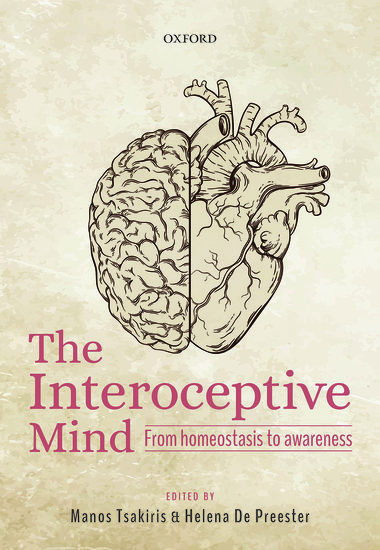
The Interoceptive Mind – From Homeostasis to Awareness
Description
Interoception is the body-to-brain axis of sensations that originates from the internal body and visceral organs. It plays a unique role in ensuring homeostasis, allowing human beings to experience and perceive the state of their bodies at any one time.
However, interoception is rapidly gaining interest amongst those studying the human mind. It is believed that beyond homeostasis interoception is fundamental in understanding human emotion and motivation and their impact upon behavior. That link between interoception and self-awareness is supported by a growing body of experimental findings.
The InteroceptiveMind: From Homeostasis to Awareness offers a state-of-the-art overview of, and insights into, the role of interoception for mental life, awareness, subjectivity, affect, and cognition. Structured across three parts, this multidisciplinary volume highlights the role that interoceptive signals, and our awareness of them, play in our mental life. It considers deficits in interoceptive processing and awareness in various mental health conditions. But it also considers the equally important role of interoception for well-being, approaching interoception from both a theoretical and a philosophical perspective.
Written by leading experts in their fields, all chapters within this volume share a common concern for what it means to experience oneself, for the crucial role of emotions, and for issues of health and wellbeing. Each of those concerns is discussed on the joint basis of our bodily existence and interoception. The research presented here will undoubtedly accelerate the much-anticipated coming of age of interoceptive research in psychology, cognitive neurosciences and philosophy, making this vital reading for anyone working in those fields.
- Keywords: interoception, homeostasis, allostasis, predictive coding, emotion, motivation, mental health, (self-)awareness, subjectivity, affect, cognition
- Table of Contents online
Details
Editors: Manos Tsakiris, Helena De Preester
Contributors: Micah Allen, Qasim Aziz, Mariana Babo-Rebelo, Gary G. Berntson, Giovanna Colombetti, Andrew W. Corcoran, Hugo D. Critchley, Helena De Preester, Frédérique de Vignemont, Norman A. S. Farb, Justin S. Feinstein, Aikaterini Fotopoulou, Adolfo M. García, Indira García-Cordero, Sarah N Garfinkel, Peter J. Gianaros, Neil Harrison, Beate M. Herbert, Jakob Hohwy, Agustín Ibáñez, Sahib S. Khalsa, Drew Leder, Kyle Logie, Karin Meissner, Sibylle Petersen, Olga Pollatos, Lisa Quadt, James K Ruffle, Paula Salamone, Lucas Sedeño, Catherine Tallon-Baudry, Manos Tsakiris, Omer Van den Bergh, Mariana von Mohr, Marc Wittmann, Adrián Yoris, Nadia Zacharioudakis
Publisher: Oxford University Press
Year of publication: 2018
Sensitivity to Differences in the Motor Origin of Drawings: From Human to Robot
Abstract
This study explores the idea that an observer is sensitive to differences in the static traces of drawings that are due to differences in motor origin. In particular, our aim was to test if an observer is able to discriminate between drawings made by a robot and by a human in the case where the drawings contain salient kinematic cues for discrimination and in the case where the drawings only contain more subtle kinematic cues. We hypothesized that participants would be able to correctly attribute the drawing to a human or a robot origin when salient kinematic cues are present. In addition, our study shows that observers are also able to detect the producer behind the drawings in the absence of these salient kinematic cues. The design was such that in the absence of salient kinematic cues, the drawings are visually very similar, i.e. only differing in subtle kinematic differences. Observers thus had to rely on these subtle kinematic differences in the line trajectories between drawings. However, not only motor origin (human versus robot) but also motor style (natural versus mechanic) plays a role in attributing a drawing to the correct producer, because participants scored less high when the human hand draws in a relatively mechanical way. Overall, this study suggests that observers are sensitive to subtle kinematic differences between visually similar marks in drawings that have a different motor origin. We offer some possible interpretations inspired by the idea of “motor resonance”.
- Keywords: drawing, human hand, robot drawing, kinematics, gesture, motor, motor resonance, movement, static traces
- Open access
Details
Source: PLoS ONE 9(7): e102318. https://doi.org/10.1371/journal.pone.0102318
Author(s): Helena De Preester, Manos Tsakiris
Year of publication: 2014
Investing in the Act of Painting: Ilse D’Hollander and the Question of Painting
Context
The paintings of Ilse D’Hollander (Sint-Niklaas, 1968-1997) result from a personal search for the medium of painting. Via meticulous observation of her immediate environment, Ilse D’Hollander created compositions of colored surfaces and lines, vibrating forms and transparent overpainting. Visual elements from the landscape, such as a branch, house, or road, are transformed into more abstract visual language that vacillates between the recognizable, suggestive, determined and more poetic.
Some of her works may be linked to painters like Paul Cezanne, René Daniels or Raoul De Keyser. In only a brief period, between 1989 and 1997, Ilse D’Hollander created an extensive oeuvre of paintings and drawings.
With texts by Eva Wittocx, Tanguy Eeckhout, Helena De Preester and David Nash.

- Keywords: Ilse D’Hollander, painting, act of painting, abstract, sensory, body, Merleau-Ponty
Details
Source: Ilse D’Hollander: Untitled (artist monograph), pp. 59-64 (Dutch), pp. 109-114 (English). Publisher: The Estate Ilse D’Hollander and Hannibal Publishing, 256 pp.
Author(s): Helena De Preester
Year of publication: 2013
Living Lines: Can We Discriminate Between Traces of Movement by Animate and Non-Animate Agents?
Abstract
This chapter examines the viewer’s sensitivity to the movements behind a drawn image. The images discussed are made by two different kinds of agents: animate and non-animate, and we examine if and how the viewer is able to discriminate the producer behind the drawings. We first present a number of recent theoretical insights and empirical results as to how observers perceive movements produced by animate and non- animate agents, and how they are able to correctly attribute drawn lines to the agent that produced it. We next present the results of a pilot study that suggests that participants are indeed able to discriminate between similar-looking drawings produced by humans and by a robot. The notion of motor resonance guides our explanation.
- Keywords: drawing, human hand, robot drawing, mirror neurons, gesture, motor, motor resonance, movement, static traces
Details
Source: Images of Animate Movement. Representations of Life/Bilder animierter Bewegung. Darstellungen von Leben, pp. 181-196.
Author(s): Helena De Preester, Manos Tsakiris
Editors: S. Leyssen, P. Rathgeber
Publisher: München: Wilhelm Fink Verlag
Year of publication: 2013
Moving Imagination – Explorations of Gesture and Inner Movement in the Arts
Description
This volume brings together contributions by philosophers, art historians and artists who discuss, interpret and analyse the moving and gesturing body in the arts. Broadly inspired by phenomenology, and taking into account insights from cognitive science, the contribution of the motor body in watching a film, attending a dance or theatre performance, looking at paintings or drawings, and listening to music is explored from a diversity of perspectives. This volume is intended for both the specialist and non-specialist in the fields of art, philosophy and cognitive science, and testifies to the burgeoning interest for the moving and gesturing body, not only in the creation but also in the perception of works of art. Imagination is tied to our capacity to silently resonate with the way a work of art has been or is created.
- Keywords: cognitive science, music, theatre studies, art, gesture, embodied cognition, embodiment, phenomenology, body, imagination, listening (music), artistic creation, art and perception, psychology of perception in arts, moving body
- Table of Contents
Details
Editor: Helena De Preester
Contributors: see Table of Contents
Publisher: John Benjamins Publishing Company
Year of publication: 2013
Merleau-Ponty’s sexual schema and the sexual component of body integrity identity disorder
Abstract
Body integrity identity disorder (BIID), formerly also known as apotemnophilia, is characterized by a desire for amputation of a healthy limb and is claimed to straddle or to even blur the boundary between psychiatry and neurology. The neurological line of approach, however, is a recent one, and is accompanied or preceded by psychodynamical, behavioural, philosophical, and psychiatric approaches and hypotheses. Next to its confusing history in which the disorder itself has no fixed identity and could not be classified under a specific discipline, its sexual component has been an issue of unclarity and controversy, and its assessment a criterion for distinguishing BIID from apotemnophilia, a paraphilia. Scholars referring to the lived body – a phenomenon primarily discussed in the phenomenological tradition in philosophy – seem willing to exclude the sexual component as inessential, whereas other authors notice important similarities with gender identity disorder or transsexualism, and thus precisely focus attention on the sexual component. This contribution outlines the history of BIID highlighting the vicissitudes of its sexual component, and questions the justification for distinguishing BIID from apotemnophilia and thus for omitting the sexual component as essential. Second, we explain a hardly discussed concept from Maurice Merleau-Ponty’s Phenomenology of Perception (1945), the sexual schema, and investigate how the sexual schema could function in interaction with the body image in an interpretation of BIID which starts from the lived body while giving the sexual component its due.
- Keywords: BIID, apotemnophilia, lived body, Merleau-Ponty, sexual schema, body image
Details
Source: Medicine, health care, and philosophy, 16(2), 171–184. DOI: 10.1007/s11019-011-9367-3
Author(s): Helena De Preester
Year of publication: 2013
Equipment and Existential Spatiality: Heidegger, Cognitive Science and the Prosthetic Subject
Abstract
This chapter examines the relation between the body and technics. The term ‘technics’ is preferred over the term ‘technology’ for a number of reasons. First, Heidegger, in The Question Concerning Technology (1977, first published in 1962 as Die Frage nach der Technik) does not use the word ‘technology’ (Technologie) but he consistently applies the word ‘technics’ (Technik). Another reason is found in Don Ihde’s introduction to his Existential Technics (1983), where Ihde prefers the word ‘technics’ ‘because it conjures up a sense of action and artifact which I believe important for a focal understanding of technology. Technics stands in between the too abstract “technique” which can refer to any set action with or without a material object, and the sometimes too narrow sense of technology as a collection of tools or machinery.’ (Ihde, 1983, p. 1). ‘Technics’ points to the use of artifacts in action, and in this sense it plays an important role in the present chapter, in which the following questions are dealt with. What is the precise relation between a human being and the object or the artifact she or he is using to act with? What is the meaning of this peculiar relation, and how is this relation possible?
- Keywords: Heidegger, equipment, readiness-to-hand, tools, Dasein’s spatiality, body extension, prosthesis
Details
Source: pp. 276-308 in Heidegger and Cognitive Science (Eds. Kiverstein, J., Wheeler, M.). New York: Palgrave McMillan.
Author(s): Helena De Preester
Year of publication: 2012
Het technologische lichaam als utopie
Abstract
Veel filosofen buigen zich tegenwoordig over het hybride thema van de technologische mens. Lichaam en technologie zijn legitieme onderwerpen geworden binnen een traditie die zich althans volgens haar officiële geschiedenis aan geen van beide veel gelegen liet liggen. Bovendien bevredigt deze gecombineerde thematiek een zucht naar actualiteit en maatschappelijke verantwoording van een discipline die vaak het verwijt krijgt van al te wereldvreemde abstractie en maatschappelijke irrelevantie. Wat in de filosofie contemporain is, en dus aan de orde, valt echter niet zo gemakkelijk vast te stellen. Niet alles wat het aura van het hedendaagse draagt, is ook werkelijk actueel en dus aan de orde. De vraag in deze bijdrage is of het brandend actuele thema van de verhouding tussen mens en technologie niet vaak onopgemerkt ingesleten paden volgt. Is ons basisrecept voor het denken van de technologische mens geen recept dat we vooral uit gewoonte en dus haast blindelings
volgen? Als we deze vraag op tafel leggen en het schema dat we hanteren ondervragen, vinden we misschien ook een verklaring waarom het technologische lichaam zo snel leidt tot utopieën en dystopieën. De cyborg en zijn verwanten brengen ons immers opmerkelijk snel, schijnbaar moeiteloos en onvermijdelijk tot visioenen over een toekomst verscheurd tussen rampspoed en heil.
- Keywords: lichaam, technologie, Foucault, Freud, Agamben, Stiegler, cyberpunk, utopie, dystopie, posthumanisme, transhumanisme
Details
Source: Algemeen Nederlands Tijdschrift voor Wijsbegeerte, 104(3), 222-236
Author(s): Helena De Preester
Year of publication: 2012
Technology and the myth of ‘natural man’: a response to Don Ihde and Charles Lenay
Abstract
The main suggestions and objections raised by Don Ihde and Charles Lenay to my ‘Technology and the body: the (im)possibilities of re-embodiment’ are summarized and discussed. On the one hand, I agree that we should pay more attention to whole body experience and to further resisting Cartesian assumptions in the field of cognitive neuroscience and philosophy of cognition. On the other hand, I explain that my account in no way presupposes the myth of ‘natural man’ or of a natural, delineated body from before the fall into technology.
- Keywords: embodiment, extension, incorporation, technology, Don Ihde, Bernard Stiegler
Details
Source: Foundations of Science 17(4), pp. 385-390 https://doi.org/10.1007/s10699-011-9246-7
Author(s): Helena De Preester
Year of publication: 2012
The Sensory Component of Imagination: the Motor Theory of Imagination as a Present-Day Solution to Sartre’s Critique
Abstract
Several recent accounts claim that imagination is a matter of simulating perceptual acts. Although this point of view receives support from both phenomenological and empirical research, I claim that Jean-Paul Sartre’s worry formulated in L’imagination (1936) still holds. For a number of reasons, Sartre heavily criticizes theories in which the sensory material of imaginative acts consists in reviving sensory impressions. Based on empirical and philosophical insights, this article explains how simulation theories of imagination can overcome Sartre’s critique by paying attention to the motor dimension of imagination. Intending to clarify the status of the sensory in imagination, a motor theory of imagination is presented in which the sensory component of imagination is interpreted in terms of anticipated sensory consequences of preparation for motor action.
- Keywords: anticipation; cognitive science; hylè; imagination; motor; phenomenology; Sartre; sensory; simulation
Details
Source: Philosophical Psychology 25(4), pp. 503-520
DOI: 10.1080/09515089.2011.622362
Author(s): Helena De Preester
Year of publication: 2012
The Role of the Artist’s Gesture in the Perception of Art and Artistic Style
Abstract
The perception of art is a complex and multi-layered phenomenon. One obvious aspect in perceiving and appreciating a work of art is the recognition of its representational content, either figurative or non-figurative. A second and no less important aspect is the assessment of its graphic or plastic qualities. Assessing these qualities is part of our understanding of the process in which the work has been produced. Many artists testify that this process is not primarily an activity carried out by the mind, but rather “[…] a bodily activity, one that is an expression of the lived-body’s way of being in the world.” (Wentworth, 2004: 15) The perception and appreciation of works of art therefore involves the understanding of its coming into being on the basis of the artist’s gestures. In this contribution, these two related ideas are elaborated on the basis of a number of phenomenological insights. First, the Husserlian idea that in the perception of cultural objects their coming into being is appresented, and second the idea that in the art of drawing, this is a matter of appresentation of the draftsman bodily gestures.
- Keywords: art; Husserl; appresentation; empathy; drawing; gesture
Details
Source: pp 15-19 in Art and Science, vol. IX, Proceedings of a Special Focus Symposium on Art and Science, The 23rd International conference on systems research, informatics and cybernetics (eds. G.E. Lasker, H. Schinzel, K. Boullart, H. De Preester, J. Galle), Tecumseh, Canada: The International Institute for Advanced Studies in Systems Research and Cybernetics.
Author(s): Helena De Preester
Year of publication: 2011
Technology and the Body: the (Im)Possibilities of Re-Embodiment
Abstract
This article argues for a more rigorous distinction between body extensions on the one hand and incorporation of non-bodily objects into the body on the other hand. Real re-embodiment would be a matter of taking things (most often technologies) into the body, i.e. of incorporation of non-bodily items into the body. This, however, is a difficult process often limited by a number of conditions of possibility that are absent in the case of ‘mere’ body extensions. Three categories are discussed: limb extensions/prostheses, perceptual extensions/prostheses and cognitive extensions/prostheses. For each category, a distinction between extensions and incorporations is proposed, and the conditions of possibility for real incorporation are discussed. These conditions of possibility differ in each category, but in general they ask for radical or fundamental alterations not only in the motor and/or sensory or cognitive constitution of a human subject, but also in his or her subjective experience.
- Keywords: bodily extension; cognitive extension, prostheses, re-embodiment
Details
Source: Foundations of Science, 16(2), pp. 119-137
https://doi.org/10.1007/s10699-010-9188-5
Author(s): Helena De Preester, with commentaries by Don Ihde and Charles Lenay
Year of publication: 2011
Lichamelijke integriteit: lichaamsmodel, lichaamsbeeld en identificatie
Abstract
Deze bijdrage focust op lichamelijke integriteit, in de zin van de subjectieve, lichamelijke ervaring van volledigheid. Ons fysische lichaam, dat door verwonding of ziekte kan worden gemutileerd/beschadigd, kan in een aantal gevallen worden gerepareerd of opnieuw ‘vervolledigd’ door prothesen of door transplantatie van een lichaamsdeel. In onze tijd van zowel cyborgfantasieën als daadwerkelijke manipulaties van het lichaam, kan een opheldering en een verkenning van de grenzen van de plasticiteit van onze lichamelijke integriteit nuttig zijn. Eerst maken we een zo helder mogelijk onderscheid tussen lichamelijke extensies enerzijds (bijvoorbeeld in het geval van het gebruik van instrumenten) en incorporatie van lichaamsvreemde entiteiten anderzijds (bijvoorbeeld in het geval van prothesen). Dit leidt tot de hypothese van een lichaamsmodel dat op normatieve wijze beperkingen oplegt aan wat al dan niet in het lichaam kan worden geïncorporeerd. Daarna gaan we in op de kwestie van re-identificatie met het eigen veranderde lichaam. Het herstel van iemands ervaring van lichamelijke volledigheid vereist immers een proces van re-identificatie met het eigen lichaam. Om dit proces te beschrijven zullen we gebruik maken van de psychoanalytische analyse van het spiegelstadium en de fenomenologische beschrijving van Leib (lijf) en Körper (fysisch lichaam). De twee pistes van lichaamsmodel en re-identificatie worden hierbij getest op verklaringskracht en hun eventuele compatibiliteit.
- Keywords: bodily integrity; bodily extension; incorporation; body model; body image; re-identification with changed body; BIID; phenomenology; mirror stage
Details
Source: pp. 189-214 in Psychoanalyse en neurowetenschap: de geest in de machine.
Author(s): Helena De Preester, Jenny Slatman
Editor(s): M. Kinet, A. Bazan
Publisher: Antwerpen/Apeldoorn: Garant Uitgevers
Year of publication: 2010
 Contemporary Emotions in Art, Technology and Politics