Descartes on the Passions of the Soul and Internal Emotions. Two Challenges for Interoception Research in Emotions
Abstract
René Descartes is not only praised as the father of modern philosophy, but he is also famous (or infamous) for mind-body dualism. In his later writings on the passions, however, it becomes clear that the passions of the soul do not fit well with the distinction between body and soul. We join the exploration of Descartes’s work on the passions of the soul and the union of the mind and the body. On the basis of Descartes’s account of the passions of the soul, we argue that current interoception-based theories of emotions cannot account for the hallmark of a passion of the soul, i.e. that its effects are felt as being in the soul itself. We also pay attention to the epistemic functions of the passions and to Descartes’s belief that there is a category of emotions which “are caused and occur in the soul alone”. This is the class of internal or intellectual emotions that seems to reinstate mind-body dualism. As Descartes describes them, certain passions of the soul, but also certain internal or intellectual emotions are similar to, what are called today, epistemic feelings (also called noetic feelings) and epistemic emotions, collectively referred to here as epistemic affect. Descartes’s work on the passions and on internal and intellectual emotions reflects another challenge for contemporary embodied cognition in the effort to overturn Cartesian dualism: how might epistemic affect be embodied? Since the signature of embodiment is increasingly understood as written in interoceptive information, the challenge to interoceptive research is demonstrating the degree to which (epistemic) affect results from the processing of interoceptive information. This challenge also implies that the locus of emotional experience is taken into account.
- Keywords: Descartes, passions of the soul, internal emotions, intellectual emotions, mind-body dualism, epistemic affect, interoception, noetic feelings, epistemic feelings, epistemic emotions
Details
Source: Danish Yearbook of Philosophy 2021, pp. 1-28.
Author(s): Helena De Preester, John Dorsch
Year of publication: 2021
The Interoceptive Mind – From Homeostasis to Awareness
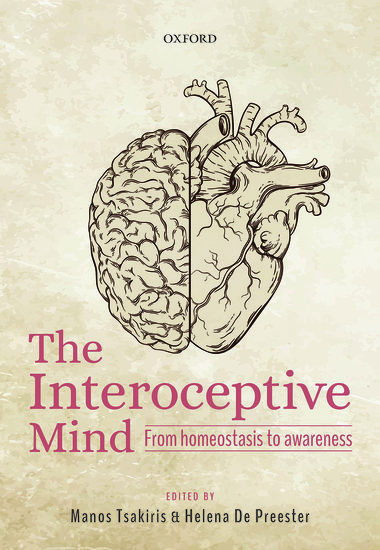
Description
Interoception is the body-to-brain axis of sensations that originates from the internal body and visceral organs. It plays a unique role in ensuring homeostasis, allowing human beings to experience and perceive the state of their bodies at any one time.
However, interoception is rapidly gaining interest amongst those studying the human mind. It is believed that beyond homeostasis interoception is fundamental in understanding human emotion and motivation and their impact upon behavior. That link between interoception and self-awareness is supported by a growing body of experimental findings.
The InteroceptiveMind: From Homeostasis to Awareness offers a state-of-the-art overview of, and insights into, the role of interoception for mental life, awareness, subjectivity, affect, and cognition. Structured across three parts, this multidisciplinary volume highlights the role that interoceptive signals, and our awareness of them, play in our mental life. It considers deficits in interoceptive processing and awareness in various mental health conditions. But it also considers the equally important role of interoception for well-being, approaching interoception from both a theoretical and a philosophical perspective.
Written by leading experts in their fields, all chapters within this volume share a common concern for what it means to experience oneself, for the crucial role of emotions, and for issues of health and wellbeing. Each of those concerns is discussed on the joint basis of our bodily existence and interoception. The research presented here will undoubtedly accelerate the much-anticipated coming of age of interoceptive research in psychology, cognitive neurosciences and philosophy, making this vital reading for anyone working in those fields.
- Keywords: interoception, homeostasis, allostasis, predictive coding, emotion, motivation, mental health, (self-)awareness, subjectivity, affect, cognition
- Table of Contents online
Details
Editors: Manos Tsakiris, Helena De Preester
Contributors: Micah Allen, Qasim Aziz, Mariana Babo-Rebelo, Gary G. Berntson, Giovanna Colombetti, Andrew W. Corcoran, Hugo D. Critchley, Helena De Preester, Frédérique de Vignemont, Norman A. S. Farb, Justin S. Feinstein, Aikaterini Fotopoulou, Adolfo M. García, Indira García-Cordero, Sarah N Garfinkel, Peter J. Gianaros, Neil Harrison, Beate M. Herbert, Jakob Hohwy, Agustín Ibáñez, Sahib S. Khalsa, Drew Leder, Kyle Logie, Karin Meissner, Sibylle Petersen, Olga Pollatos, Lisa Quadt, James K Ruffle, Paula Salamone, Lucas Sedeño, Catherine Tallon-Baudry, Manos Tsakiris, Omer Van den Bergh, Mariana von Mohr, Marc Wittmann, Adrián Yoris, Nadia Zacharioudakis
Publisher: Oxford University Press
Year of publication: 2018
 Contemporary Emotions in Art, Technology and Politics