Life is what you fill your attention with – the war for attention and the role of digital technology in the work of Bernard Stiegler
Abstract
This contribution focuses on the topic of attention and sets forth the main points of Bernard Stiegler’s analysis of the interplay between capitalist consumer society, the destruction of attention and the consequences for individual and collective life. We look at how current digital technologies in service of the needs of the market are a major factor in the destruction of attention and discuss two counterforces that do not destroy but form attention: education and meditation. If life is what you fill your attention
with, then focusing or directing attention is one of the most valuable abilities for knowing how to live. Instead of letting our attention be hijacked by the market and the economic needs of neoliberal
capitalism, being in charge of what happens to our attention may be a basic right that needs protection given the current conditions of the attention economy.
- Keywords: attention, Bernard Stiegler, (digital) technology, education, meditation, neoliberal capitalism
- Open acces
Details
Source: Phenomenology and Mind 20, 102-116.
Author(s): Helena De Preester
Year of publication: 2021
Subjectivity and transcendental illusions in the Anthropocene
Abstract
This contribution focuses on one member in particular of the anthropocenic triad Earth – technology – humankind, namely the current form of human subjectivity that characterizes humankind in the Anthropocene. Because knowledge, desire and behavior are always embedded in a particular form of subjectivity, it makes sense to look at the current subjective structure that embeds knowledge, desire and behavior. We want to move beyond the common psychological explanations that subjects are unable to correctly assess the consequences of their current technological lifestyle or unable to change their lifestyle because
well-intended behavior is modified by factors such as laziness, lack of knowledge, seduction by convenience, etc. Instead, we will argue from a philosophical point of view that transcendental illusions play a central role in a contemporary account of subjectivity. Consumerism is considered as a means of not becoming a subject and framed in a profound
ambivalence at the heart of our acting (consuming) against better knowledge. We appeal to collective transcendental conditions of subjectivity in the Anthropocene in terms of illusions without owners – a term borrowed from Robert Pfaller’s work on interpassivity. Central in our account is the idea that illusions without owners are the conditions of possibility for the disconnection between knowledge and behavior – the characteristic par excellence of the Anthropocene.
- Keywords: Subjectivity · Anthropocene · Consumerism · Ambivalence · Illusions without owners · Commodification
- Open acces
Details
Source: Foundations of Science. DOI: 10.1007/s10699-020-09733-6
Author(s): Helena De Preester
Year of publication: 2021
A radical phenomenology of the body: subjectivity and sensations in body image and body schema
Abstract
The role of sensations for body experience and body representations such as body image and body schema seems indisputable. This chapter discusses the link between sensory input, the experience of one’s own body, and body representations such as body image and body schema. That happens on the basis of Michel Henry’s radical phenomenology of the body, which unites body and subjectivity and reconsiders the role of sensory input for the experience of the body and related representations. Without supporting, but inspired by, Henry’s ontological dualism between subjective and objective body, it is argued that the traditional view that considers sensory signals as all-important for bodily experience misses out a bodily dimension crucial for subjectivity—the body’s subjective dimension, not reigned by current sensory input.
This chapter has a twofold aim. First, it introduces Henry’s little-known, but radical, phenomenology of the body. Second, and based on Henry’s phenomenology of the body, it shows that attention for the subjective body is at odds with the all-important role of sensory signals in the current embodiment studies.
- Keywords: embodiment, sensory signals, sensations, Michel Henry, phenomenology, bodily experience, body image, body schema, body representations, subjective body, objective body
Details
Source: In Body Image and Body Schema Revisited (Eds. Tanaka, S., Ataria, Y., Gallagher, S.). Oxford: Oxford University Press.
Author(s): Helena De Preester
Year of publication: 2021
Subjectivity as a sentient perspective and the role of interoception
Abstract
Subjects and objects are radically different beings, distinguished by a basic feature that all subjects have in common, and that all objects seem to lack. Objects seem to rest in themselves, unaware of, insensitive to and unconcerned about what is happening to them or in the environment. A subject, in contrast, is a sentient perspective that breaches the selfenclosed state of objects and opens up a world.
This chapter argues that the most basic form of subjectivity is different from and more fundamental than having a self. It also forwards a hypothesis about the origin of subjectivity in terms of interoception. Both topics have been on the agenda of philosophers, psychologists and neuroscientists before, but now a consensus concerning the homeostatic-interoceptive origin of subjectivity is growing in these domains of research. This chapter critically explores that growing consensus. In particular, it argues that the idea that the brain topographically represents bodily states is unfit for thinking about the coming about of subjectivity. The
reason is that representation implies objectification – and thus the irreparable disappearance – of subjectivity. We therefore present an approach that preserves the importance of interoceptive processes for the coming about of subjectivity, but gives due to its inherent characteristics.
In the first part, four inherent characteristics of subjectivity are discussed from a philosophical point of view. The second part explores whether an approach of subjectivity in which interoception maintains its crucial role is possible without relying on topographic representations of the in-depth body, and giving due to the inherent characteristics of subjectivity.
- Keywords: awareness, self-awareness, subjectivity, interoception, body representation, in-depth body, neuroscience, Damasio, Craig
Details
Source: The Interoceptive Mind – From Homeostasis to Awareness. Oxford: Oxford University Press.
Author(s): Helena De Preester
Year of publication: 2018
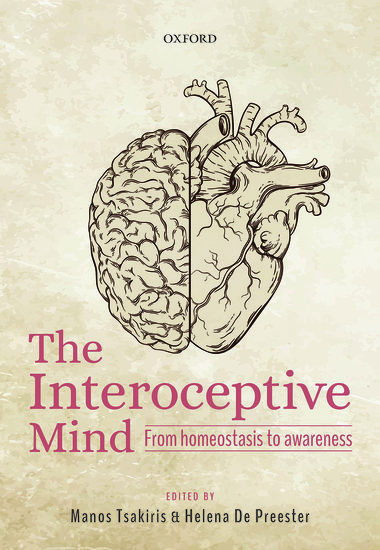
The Interoceptive Mind – From Homeostasis to Awareness
Description
Interoception is the body-to-brain axis of sensations that originates from the internal body and visceral organs. It plays a unique role in ensuring homeostasis, allowing human beings to experience and perceive the state of their bodies at any one time.
However, interoception is rapidly gaining interest amongst those studying the human mind. It is believed that beyond homeostasis interoception is fundamental in understanding human emotion and motivation and their impact upon behavior. That link between interoception and self-awareness is supported by a growing body of experimental findings.
The InteroceptiveMind: From Homeostasis to Awareness offers a state-of-the-art overview of, and insights into, the role of interoception for mental life, awareness, subjectivity, affect, and cognition. Structured across three parts, this multidisciplinary volume highlights the role that interoceptive signals, and our awareness of them, play in our mental life. It considers deficits in interoceptive processing and awareness in various mental health conditions. But it also considers the equally important role of interoception for well-being, approaching interoception from both a theoretical and a philosophical perspective.
Written by leading experts in their fields, all chapters within this volume share a common concern for what it means to experience oneself, for the crucial role of emotions, and for issues of health and wellbeing. Each of those concerns is discussed on the joint basis of our bodily existence and interoception. The research presented here will undoubtedly accelerate the much-anticipated coming of age of interoceptive research in psychology, cognitive neurosciences and philosophy, making this vital reading for anyone working in those fields.
- Keywords: interoception, homeostasis, allostasis, predictive coding, emotion, motivation, mental health, (self-)awareness, subjectivity, affect, cognition
- Table of Contents online
Details
Editors: Manos Tsakiris, Helena De Preester
Contributors: Micah Allen, Qasim Aziz, Mariana Babo-Rebelo, Gary G. Berntson, Giovanna Colombetti, Andrew W. Corcoran, Hugo D. Critchley, Helena De Preester, Frédérique de Vignemont, Norman A. S. Farb, Justin S. Feinstein, Aikaterini Fotopoulou, Adolfo M. García, Indira García-Cordero, Sarah N Garfinkel, Peter J. Gianaros, Neil Harrison, Beate M. Herbert, Jakob Hohwy, Agustín Ibáñez, Sahib S. Khalsa, Drew Leder, Kyle Logie, Karin Meissner, Sibylle Petersen, Olga Pollatos, Lisa Quadt, James K Ruffle, Paula Salamone, Lucas Sedeño, Catherine Tallon-Baudry, Manos Tsakiris, Omer Van den Bergh, Mariana von Mohr, Marc Wittmann, Adrián Yoris, Nadia Zacharioudakis
Publisher: Oxford University Press
Year of publication: 2018
Merleau-Ponty’s sexual schema and the sexual component of body integrity identity disorder
Abstract
Body integrity identity disorder (BIID), formerly also known as apotemnophilia, is characterized by a desire for amputation of a healthy limb and is claimed to straddle or to even blur the boundary between psychiatry and neurology. The neurological line of approach, however, is a recent one, and is accompanied or preceded by psychodynamical, behavioural, philosophical, and psychiatric approaches and hypotheses. Next to its confusing history in which the disorder itself has no fixed identity and could not be classified under a specific discipline, its sexual component has been an issue of unclarity and controversy, and its assessment a criterion for distinguishing BIID from apotemnophilia, a paraphilia. Scholars referring to the lived body – a phenomenon primarily discussed in the phenomenological tradition in philosophy – seem willing to exclude the sexual component as inessential, whereas other authors notice important similarities with gender identity disorder or transsexualism, and thus precisely focus attention on the sexual component. This contribution outlines the history of BIID highlighting the vicissitudes of its sexual component, and questions the justification for distinguishing BIID from apotemnophilia and thus for omitting the sexual component as essential. Second, we explain a hardly discussed concept from Maurice Merleau-Ponty’s Phenomenology of Perception (1945), the sexual schema, and investigate how the sexual schema could function in interaction with the body image in an interpretation of BIID which starts from the lived body while giving the sexual component its due.
- Keywords: BIID, apotemnophilia, lived body, Merleau-Ponty, sexual schema, body image
Details
Source: Medicine, health care, and philosophy, 16(2), 171–184. DOI: 10.1007/s11019-011-9367-3
Author(s): Helena De Preester
Year of publication: 2013
Verzet en transcendentaal empirisme. Over Catherine Malabous Wat te doen met ons brein?
Abstract
Deze bijdrage bespreekt Catherine Malabous Wat te doen met ons brein? Daarin zet ze uiteen hoe de recente ontwikkelingen in de neurowetenschappen ons zouden moeten afhelpen van de oude en niet langer adequate opvatting dat de hersenen zoiets als een gecentreerd en centraliserend programma vormen (cf. de computennetafoor) waarin geen ruimte is voor wijzigingen en voor het ‘andere’. De nieuwe inzichten zouden het ons mogelijk moeten maken in verzet te komen tegen de huidige gang van zaken in de wereld, of de heersende wereldorde. Dat is een verrassende stap, en het is precies in die stap dat de kracht schuilt van het discours van Malabou. Helaas is die stap van recente neurowetenschappelijke inzichten naar verzet en vrijheid niet zo gemakkelijk te nemen. Malabou ontwaart immers een ‘ideologisch scherm’ (67) dat ons weerhoudt van de mogelijkheid tot verzet. Dat heeft alles te maken met een parallellie tussen het neurale en het politieke, tussen het neurowetenschappelijke discours en het heersende managementsdiscours. Het hoopvolle uitgangspunt van Malabou is dat “[D]e vooruitgang in de neurowetenschappen [ … ]op een bepaalde manier de politieke emancipatie van de hersenen mogelijk [heeft] gemaakt” (88). Het probleem wordt echter gevormd door de ambivalentie die in de zaak schuilt, aangezien de plasticiteit van de hersenen wordt weerspiegeld (ook bij een aantal neurowetenschappers) door een discours dat flexibiliteit en dus volgzaamheid en gehoorzaamheid vooropstelt. Malabou ‘ontmaskert’ dus geen verondersteld ideologisch gehalte van het strikt neurowetenschappelijke onderzoek als zodanig. Ze roept wel op tot iets wat ze slechts erg complex kan verwoorden, doordat de koppeling die zij maakt tussen neurowetenschappen, kapitalisme en politiek verzet nieuw is.
- Keywords: Catherine Malabou, brein, plasticiteit, flexibiliteit, ideologie, neurodiscours
Details
Source: De Uil van Minerva, 25(1), pp. 87-100
Author(s): Helena De Preester
Year of publication: 2012
Technology and the myth of ‘natural man’: a response to Don Ihde and Charles Lenay
Abstract
The main suggestions and objections raised by Don Ihde and Charles Lenay to my ‘Technology and the body: the (im)possibilities of re-embodiment’ are summarized and discussed. On the one hand, I agree that we should pay more attention to whole body experience and to further resisting Cartesian assumptions in the field of cognitive neuroscience and philosophy of cognition. On the other hand, I explain that my account in no way presupposes the myth of ‘natural man’ or of a natural, delineated body from before the fall into technology.
- Keywords: embodiment, extension, incorporation, technology, Don Ihde, Bernard Stiegler
Details
Source: Foundations of Science 17(4), pp. 385-390 https://doi.org/10.1007/s10699-011-9246-7
Author(s): Helena De Preester
Year of publication: 2012
The Sensory Component of Imagination: the Motor Theory of Imagination as a Present-Day Solution to Sartre’s Critique
Abstract
Several recent accounts claim that imagination is a matter of simulating perceptual acts. Although this point of view receives support from both phenomenological and empirical research, I claim that Jean-Paul Sartre’s worry formulated in L’imagination (1936) still holds. For a number of reasons, Sartre heavily criticizes theories in which the sensory material of imaginative acts consists in reviving sensory impressions. Based on empirical and philosophical insights, this article explains how simulation theories of imagination can overcome Sartre’s critique by paying attention to the motor dimension of imagination. Intending to clarify the status of the sensory in imagination, a motor theory of imagination is presented in which the sensory component of imagination is interpreted in terms of anticipated sensory consequences of preparation for motor action.
- Keywords: anticipation; cognitive science; hylè; imagination; motor; phenomenology; Sartre; sensory; simulation
Details
Source: Philosophical Psychology 25(4), pp. 503-520
DOI: 10.1080/09515089.2011.622362
Author(s): Helena De Preester
Year of publication: 2012
Technology and the Body: the (Im)Possibilities of Re-Embodiment
Abstract
This article argues for a more rigorous distinction between body extensions on the one hand and incorporation of non-bodily objects into the body on the other hand. Real re-embodiment would be a matter of taking things (most often technologies) into the body, i.e. of incorporation of non-bodily items into the body. This, however, is a difficult process often limited by a number of conditions of possibility that are absent in the case of ‘mere’ body extensions. Three categories are discussed: limb extensions/prostheses, perceptual extensions/prostheses and cognitive extensions/prostheses. For each category, a distinction between extensions and incorporations is proposed, and the conditions of possibility for real incorporation are discussed. These conditions of possibility differ in each category, but in general they ask for radical or fundamental alterations not only in the motor and/or sensory or cognitive constitution of a human subject, but also in his or her subjective experience.
- Keywords: bodily extension; cognitive extension, prostheses, re-embodiment
Details
Source: Foundations of Science, 16(2), pp. 119-137
https://doi.org/10.1007/s10699-010-9188-5
Author(s): Helena De Preester, with commentaries by Don Ihde and Charles Lenay
Year of publication: 2011
Lichamelijke integriteit: lichaamsmodel, lichaamsbeeld en identificatie
Abstract
Deze bijdrage focust op lichamelijke integriteit, in de zin van de subjectieve, lichamelijke ervaring van volledigheid. Ons fysische lichaam, dat door verwonding of ziekte kan worden gemutileerd/beschadigd, kan in een aantal gevallen worden gerepareerd of opnieuw ‘vervolledigd’ door prothesen of door transplantatie van een lichaamsdeel. In onze tijd van zowel cyborgfantasieën als daadwerkelijke manipulaties van het lichaam, kan een opheldering en een verkenning van de grenzen van de plasticiteit van onze lichamelijke integriteit nuttig zijn. Eerst maken we een zo helder mogelijk onderscheid tussen lichamelijke extensies enerzijds (bijvoorbeeld in het geval van het gebruik van instrumenten) en incorporatie van lichaamsvreemde entiteiten anderzijds (bijvoorbeeld in het geval van prothesen). Dit leidt tot de hypothese van een lichaamsmodel dat op normatieve wijze beperkingen oplegt aan wat al dan niet in het lichaam kan worden geïncorporeerd. Daarna gaan we in op de kwestie van re-identificatie met het eigen veranderde lichaam. Het herstel van iemands ervaring van lichamelijke volledigheid vereist immers een proces van re-identificatie met het eigen lichaam. Om dit proces te beschrijven zullen we gebruik maken van de psychoanalytische analyse van het spiegelstadium en de fenomenologische beschrijving van Leib (lijf) en Körper (fysisch lichaam). De twee pistes van lichaamsmodel en re-identificatie worden hierbij getest op verklaringskracht en hun eventuele compatibiliteit.
- Keywords: bodily integrity; bodily extension; incorporation; body model; body image; re-identification with changed body; BIID; phenomenology; mirror stage
Details
Source: pp. 189-214 in Psychoanalyse en neurowetenschap: de geest in de machine.
Author(s): Helena De Preester, Jenny Slatman
Editor(s): M. Kinet, A. Bazan
Publisher: Antwerpen/Apeldoorn: Garant Uitgevers
Year of publication: 2010
Johann Gottlieb Fichte: Fundering van de Gehele Wetenschapsleer (vertaling)
Description
Vertaling uit het Duits door Henk Vandaele (red.) Helena De Preester en Gert Van de Vijver. Bijlage bij het proefschrift “The Thin Red Line – Het transcendentale grensbegrip als grondslag voor een topica” door Henk Vandaele.
Details
Source: Johann Gottlieb Fichte: Fundering van de Gehele Wetenschapsleer. Bijlage bij het proefschrift ‘The Thin Red Line – Het transcendentale grensbegrip als grondslag voor een topica’ door Henk Vandaele. (isbn: 978-90- 7083-006-9)
Translator(s): Henk Vandaele, Helena De Preester, Gert Van de Vijver
Editor(s): H. Vandaele
Publisher: Gent: University Press
Year of publication: 2010
 Contemporary Emotions in Art, Technology and Politics